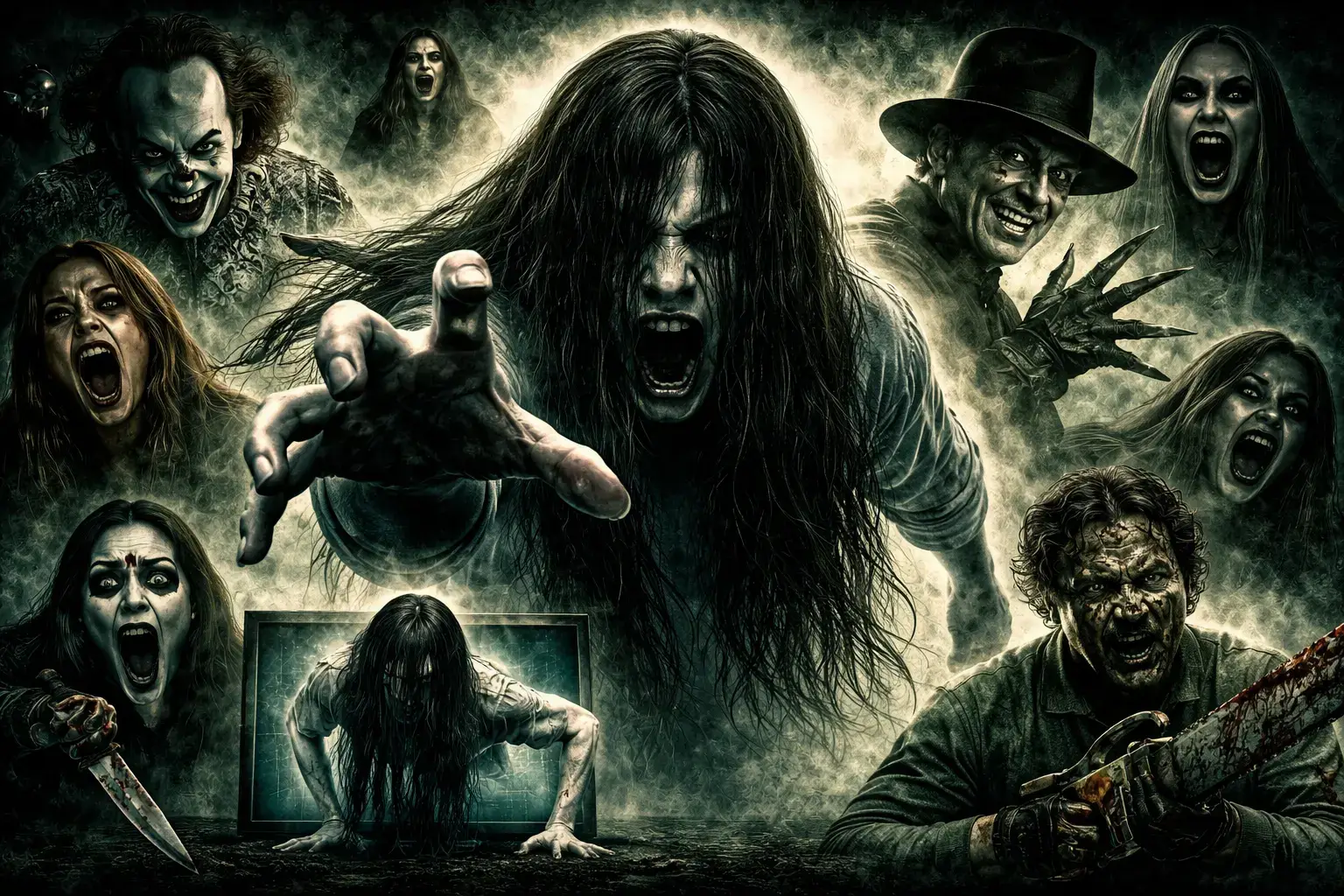
There is a reason people keep coming back to horror. It is the only genre that can make you feel something physically while sitting completely still in a dark room. Done right, a horror film does not just scare you; it gets under your skin, changes how you feel about a noise in the hallway, and occasionally makes you rethink whether you ever needed a basement.
This list covers the 15 best horror movies of all time, ranked by verified IMDb scores. No filler, no fake data. Every film here has earned its place through genuine craft, cultural impact, and a proven ability to keep audiences up at night. The list spans from 1960 to 2018, which tells you something important: great horror is timeless, and every era has produced something genuinely terrifying.
Whether you are a lifelong horror devotee who sleeps with the lights off just to prove a point or someone who considers watching Jaws a personality trait, there is something on this list for you. Probably something that will make you regret it.
Table of Contents
Here is the List of the 15 Best Horror Movies You Must Watch
1 — The Silence of the Lambs (1991)
Director: Jonathan Demme
Stars: Jodie Foster, Anthony Hopkins, Ted Levine
Genre: Psychological Horror / Crime Thriller
IMDb: ⭐ 8.6/10 | Won all five major Academy Awards — Best Picture, Director, Actor, Actress, Screenplay
The Story
Clarice Starling is a young FBI trainee assigned to interview Dr. Hannibal Lecter, a brilliant psychiatrist and convicted cannibal, to gather psychological insight into a serial killer currently at large. The killer, known as Buffalo Bill, kidnaps and murders women for reasons that only Lecter seems to understand. The deal is simple: Clarice gives Lecter personal information about herself, and Lecter gives her clues. What unfolds is one of cinema’s great intellectual duels, wrapped inside a race-against-time thriller that never lets you catch your breath.
Why It’s Here
The Silence of the Lambs is the only horror film ever to win the Best Picture Oscar. It swept all five major categories in 1992, something only two other films in history have achieved. Anthony Hopkins won Best Actor despite appearing on screen for fewer than 25 minutes total. He made every single one of those minutes count in ways that actors with two-hour screen times rarely manage.
Jodie Foster’s Clarice is one of cinema’s great protagonists. She is not a victim. She is not a damsel. She is a deeply competent person operating in a world that constantly underestimates her, and watching her navigate both Lecter and the FBI’s institutional condescension is genuinely gripping. The film holds up in 2026 as powerfully as it did in 1991. That is the definition of a classic.
Anthony Hopkins won Best Actor for under 25 minutes of screen time. The most efficient performance in Oscar history belongs to a cannibal.
2 — Psycho (1960)
Director: Alfred Hitchcock
Stars: Anthony Perkins, Janet Leigh, Vera Miles
Genre: Psychological Horror / Thriller
IMDb: ⭐ 8.5/10 | The film that invented modern horror as we know it
The Story
Marion Crane is a secretary on the run after stealing $40,000 from her employer. She stops for the night at the isolated Bates Motel, run by the softly spoken Norman Bates and his domineering, unseen mother. The film shifts radically about a third of the way through in a way that shocked 1960 audiences so deeply that Hitchcock refused to allow latecomers into theatres after screenings had started. That plot move remains one of cinema’s most audacious choices.
Why It’s Here
Before Psycho, horror meant monsters, creatures, and things from other worlds. Hitchcock pointed the genre inward and said the most frightening thing alive is another person. The Bates Motel shower scene is the most studied sequence in film history, shot over seven days with 70 different camera angles for a scene that lasts under three minutes. Bernard Herrmann’s string score for that scene is so effective that the sound of violins can still trigger genuine discomfort in people who have seen the film.
Psycho received four Academy Award nominations and earned more money than any film Hitchcock had made. It created the slasher genre, the psychological thriller genre, and the twist ending as a storytelling device. Asking what modern horror owes to Psycho is like asking what modern music owes to electricity. The answer is: everything.
Hitchcock would not let audiences in after screenings started. In 1960, that felt like a gimmick. After you see the film, you understand completely.
3 — Alien (1979)
Director: Ridley Scott
Stars: Sigourney Weaver, Tom Skerritt, John Hurt
Genre: Sci-Fi Horror
IMDb: ⭐ 8.5/10 | Won the Academy Award for Best Visual Effects; Sigourney Weaver changed cinema
The Story
The crew of the commercial spacecraft Nostromo receives a distress signal from a desolate moon and investigates. They find something they were not prepared for. One crew member returns from the surface in an unsettled state. Not long after, something breaks out of him at the dinner table and disappears into the ship. The crew systematically tries to find and kill it. The creature has other ideas, and it is considerably better at this game than they are.
Why It’s Here
Ridley Scott created one of cinema’s most suffocating atmospheres in a spaceship where the corridors are too narrow, the lights are too dim, and the creature could be anywhere. H.R. Giger’s alien design remains one of the most genuinely disturbing creatures ever put on screen. It doesn’t look like a monster. It looks like a nightmare that has been granted physical form.
Sigourney Weaver as Ellen Ripley became one of cinema’s defining protagonists. She was one of the first women in film history to survive a horror film not by being saved, but by being smarter and tougher than everything else in the room. The chestburster scene has been surprising first-time viewers for 47 years. It still works.
In space, no one can hear you scream. In your living room, your neighbours definitely can. Plan accordingly.
4 — The Shining (1980)
Director: Stanley Kubrick
Stars: Jack Nicholson, Shelley Duvall, Danny Lloyd
Genre: Psychological Horror
IMDb: ⭐ 8.4/10 | Over 1.1 million IMDb votes — horror’s most analysed film
The Story
Jack Torrance, a writer with a drinking problem and a history of violence, takes a job as winter caretaker of the remote Overlook Hotel in Colorado. He brings his wife Wendy and his son Danny, who has a psychic ability called the Shining. As the winter progresses, Jack’s behaviour deteriorates rapidly. The hotel’s supernatural history seeps into him. His family becomes trapped with a man who is progressively becoming something genuinely dangerous, while Danny sees things in the corridors that cannot possibly be there.
Why It’s Here
Kubrick made a film that Stephen King famously disliked because Kubrick was not interested in the ghost story. He was interested in something more disturbing: the mechanics of a man choosing violence against his own family. Jack Nicholson’s performance is one of cinema’s great descents. There are still film students writing dissertations about what the carpet pattern in room 237 means. Kubrick does not give you easy answers because he understood that the human mind finds ambiguity more frightening than certainty.
The Overlook Hotel is one of cinema’s great settings. It is too big, too empty, and too beautiful for something that awful to happen in it. That contrast is precisely the point.
Kubrick changed Nicholson’s dialogue repeatedly without warning to keep him genuinely unsettled. Method direction aimed at a method actor. The results are onscreen.
5 — The Thing (1982)
Director: John Carpenter
Stars: Kurt Russell, Wilford Brimley, Keith David
Genre: Sci-Fi Horror / Paranoia Thriller
IMDb: ⭐ 8.2/10 | Flopped on release, now considered one of the greatest films ever made
The Story
An American research team in Antarctica encounters a shape-shifting alien organism capable of perfectly imitating any living creature it absorbs. By the time the team understands what they are dealing with, some of them are already not who they appear to be. Trust collapses entirely. Nobody knows who is human. The film turns a group of people in an isolated setting into a paranoia pressure cooker with no release valve.
Why It’s Here
The Thing is the definitive film about distrust. Carpenter uses the Antarctic setting to strip away every safety net. There is nowhere to go. Help is weeks away. And the person next to you might not be a person. Rob Bottin’s practical special effects are still breathtaking more than 40 years later, a reminder that creativity and craft can achieve things that digital effects rarely approach.
The film was a commercial failure in 1982, partly because it opened two weeks after E.T. and audiences were not interested in a film where the alien was not friendly. It has spent the decades steadily climbing IMDb rankings and critic lists until it now sits comfortably among the greatest films in any genre. Justice, delivered slowly.
The blood test scene stretches approximately four minutes. No sequence in horror history makes you hold your breath longer.
6 — The Exorcist (1973)
Director: William Friedkin
Stars: Ellen Burstyn, Linda Blair, Max von Sydow
Genre: Supernatural Horror
IMDb: ⭐ 8.1/10 | First horror film ever nominated for Best Picture at the Academy Awards
The Story
Regan MacNeil is a 12-year-old girl living in Georgetown with her mother, actress Chris MacNeil. Regan begins exhibiting disturbing behaviour that doctors cannot explain. Her mother, desperate and running out of rational options, turns to a Jesuit priest named Father Karras. What follows is a battle between science, faith, and something that does not want to be identified or removed.
Why It’s Here
People fainted in the cinema. Some vomited. Several theatres reportedly kept nurses on standby. By 1974, The Exorcist had grossed over $441 million and received 10 Academy Award nominations, including Best Picture. That combination of mass hysteria and critical acclaim had never happened to a horror film before and has never quite happened since.
Friedkin approached the material like a documentary. He consulted real Jesuit priests, shot in an actual Georgetown house, and kept the production deliberately unglamorous. The horror feels grounded in a way that supernatural films rarely achieve because Friedkin cared less about the supernatural and more about the human beings caught in the middle of it. Ellen Burstyn’s performance as a mother watching her child become something unrecognisable is the film’s emotional core.
Friedkin kept nurses on set during filming and had the set refrigerated to 40 degrees to ensure the actors’ breath was genuinely visible. Nobody was pretending.
7 — Jaws (1975)
Director: Steven Spielberg
Stars: Roy Scheider, Robert Shaw, Richard Dreyfuss
Genre: Horror / Thriller
IMDb: ⭐ 8.1/10 | Created the summer blockbuster and made an entire generation afraid of the ocean
The Story
A massive great white shark begins attacking swimmers off the coast of Amity Island, a small beach community whose economy depends on the tourist season. Police Chief Martin Brody wants to close the beaches. The mayor does not. Brody brings in marine biologist Matt Hooper and enlists weathered shark hunter Quint, and the three of them set out on a boat that is demonstrably too small for the task. The shark is demonstrably too large for anything they brought with them.
Why It’s Here
The mechanical shark malfunctioned constantly during production, which forced Spielberg to keep it off screen far longer than planned. This turned out to be the most consequential directorial accident in cinema history. What you don’t see is more frightening than what you do, and John Williams’ two-note theme communicates dread more effectively than most films manage with their entire scores.
Jaws invented the summer blockbuster. Before it, studios released prestige films in summer because they assumed audiences wanted something light. Jaws demonstrated that audiences would pack cinemas for something genuinely scary, and Hollywood has never looked back. If you want to trace the entire modern blockbuster industry, it starts with a malfunctioning mechanical shark off Martha’s Vineyard in 1974.
The shark broke so often that Spielberg barely showed it. The lesson: what you don’t show your audience is usually scarier than what you do.
8 — Rosemary’s Baby (1968)
Director: Roman Polanski
Stars: Mia Farrow, John Cassavetes, Ruth Gordon
Genre: Psychological Horror
IMDb: ⭐ 8.0/10 | Ruth Gordon won the Academy Award for Best Supporting Actress
The Story
Rosemary and her husband Guy move into a coveted New York City apartment building with a dark history. Their elderly neighbours, Minnie and Roman Castevet, are unusually attentive and enthusiastic. Guy’s acting career suddenly begins to improve. Rosemary becomes pregnant. Her body behaves strangely. Her husband and neighbours are more interested in the pregnancy than she feels quite right. Rosemary’s instincts tell her something is deeply wrong, but everyone around her tells her she is imagining things.
Why It’s Here
Polanski’s genius was to make a horror film where the most frightening thing is not the supernatural element but the way the people around Rosemary systematically dismiss her concerns. Every instinct she has is correct. Every person she trusts tells her she is hysterical. The film works as a horror film and as a portrait of institutional gaslighting, which is probably why it has accumulated new layers of meaning with each passing decade.
Mia Farrow’s performance is extraordinary in its precision. She plays someone becoming progressively more isolated and desperate while being surrounded by people performing warmth. Ruth Gordon won an Oscar for her neighbour, Minnie, a performance so perfectly calibrated that she is completely unsettling while never doing anything that could be called obviously evil.
The most frightening thing in Rosemary’s Baby is not the baby. It is how confidently every person around her tells her that her instincts are wrong.
9 — Get Out (2017)
Director: Jordan Peele
Stars: Daniel Kaluuya, Allison Williams, Bradley Whitford
Genre: Social Horror / Thriller
IMDb: ⭐ 7.8/10 | Grossed $255 million against a $4.5 million budget; Peele won the Best Original Screenplay Oscar
The Story
Chris Washington, a young Black photographer, visits his white girlfriend Rose’s family for the weekend in their upstate New York home. Her parents, a neurosurgeon and a hypnotherapist, are aggressively welcoming in a way that creates more discomfort than warmth. The family’s Black employees behave oddly. Something is wrong with this place, and it is something much more calculated and much more disturbing than ordinary racism.
Why It’s Here
Jordan Peele made a film that works on two completely different levels simultaneously. As a horror movie, it is structurally immaculate: the slow build of dread, the escalating wrongness of the environment, the eventual terrifying reveal. As social commentary, it articulates a specific kind of racial anxiety with a precision that no non-fiction format could match.
Get Out earned $255 million worldwide against a $4.5 million production budget. Daniel Kaluuya received a Best Actor Oscar nomination. Peele won Best Original Screenplay. The film sparked discussions in film schools, cultural studies departments, and living rooms simultaneously. That kind of multi-register impact is extremely rare. Horror films win Oscars for best makeup. This one won for its script. There is a message in that.
Get Out made more than 50 times its budget at the box office. What Jordan Peele did for $4.5 million, studios spend hundreds of millions trying to replicate.
10 — Misery (1990)
Director: Rob Reiner
Stars: Kathy Bates, James Caan, Richard Farnsworth
Genre: Psychological Horror / Thriller
IMDb: ⭐ 7.8/10 | Kathy Bates won the Academy Award for Best Actress — the only horror performance to do so
The Story
Paul Sheldon, a successful novelist, crashes his car in a blizzard on a remote Colorado mountain road. He wakes up in the home of Annie Wilkes, a former nurse who describes herself as his number one fan. Annie has read every one of his books. She has opinions about all of them. She has particularly strong opinions about the one he has just finished. Paul is injured enough to be completely immobile and entirely dependent on Annie for everything. What starts as uncomfortable gratitude slowly becomes something much more frightening.
Why It’s Here
Misery is a film about captivity that never leaves a single room for most of its runtime, and it is one of the most tension-filled films ever made. Stephen King wrote Annie Wilkes as a metaphor for the relationship between an artist and their most possessive audience. Rob Reiner turned that metaphor into something viscerally terrifying.
Kathy Bates’ Annie Wilkes is one of cinema’s great antagonists because she is never presented as simply evil. She has a genuine logic to her worldview. She believes she loves Paul. That conviction, more than any weapon she holds, is what makes her so frightening. Her Oscar win marked the first and, to date, only time a horror performance has taken the Best Actress prize.
Annie Wilkes is terrifying precisely because she believes every word she says. Conviction without empathy is the engine that drives the film.
11 — Halloween (1978)
Director: John Carpenter
Stars: Jamie Lee Curtis, Donald Pleasence, Nick Castle
Genre: Slasher Horror
IMDb: ⭐ 7.7/10 | Made on $300,000. Earned $70 million. Created the slasher genre.
The Story
On Halloween night in 1963, six-year-old Michael Myers kills his teenage sister with a kitchen knife. He is committed to a psychiatric institution. Fifteen years later, he escapes and returns to his hometown of Haddonfield, Illinois. Psychiatrist Dr. Sam Loomis, who has spent fifteen years trying to understand Michael and given up, follows him. Babysitter Laurie Strode, who has no idea any of this is happening, is about to have the worst Halloween of her life.
Why It’s Here
John Carpenter made Halloween for $300,000, shooting largely in California suburbs standing in for Illinois, and using the same mask across every scene. It earned $70 million and launched one of the most enduring franchises in horror history. The genius of Michael Myers is his blankness. There is no motive. No backstory that explains him. Dr. Loomis famously describes him as ‘purely and simply evil,’ and the film commits to that framing completely. Evil without explanation is more frightening than evil with reasons.
Carpenter composed the Halloween theme himself on a piano, in 5/4 time, in approximately three minutes. It is one of the most recognisable pieces of music in film history.
The Halloween theme was composed on a budget that didn’t allow for a proper score. Three minutes, a piano, and an unusual time signature. Horror history.
12 — Hereditary (2018)
Director: Ari Aster
Stars: Toni Collette, Gabriel Byrne, Alex Wolff, Milly Shapiro
Genre: Supernatural Horror / Family Drama
IMDb: ⭐ 7.3/10 | Toni Collette’s performance is widely considered one of the greatest in horror history
The Story
Annie Graham is a miniaturist artist whose deeply difficult mother has just died. The family, including her emotionally withdrawn husband Steve, their teenage son Peter, and their unsettling younger daughter Charlie, begins to experience a series of deeply traumatic events. What initially presents as a grief story — a family falling apart under the weight of loss and inherited pain — reveals itself to be something considerably more sinister, tied to secrets that Annie’s mother carried and never shared.
Why It’s Here
Hereditary divided audiences on release. Some found it slow. Others found it the most terrifying film they had ever seen. The split says something interesting: it is a film that requires you to pay close attention. Every early scene contains information that recontextualises later scenes completely. Ari Aster built a film that rewards rewatching in a way that very few horror films manage.
Toni Collette’s performance as Annie is one of the most complete and harrowing portrayals of grief in any film, horror or otherwise. Her dinner table breakdown scene is frequently cited by actors as a masterclass. The film was her Oscar snub of the decade. The Academy’s continued reluctance to nominate horror performances regardless of quality remains one of its more baffling tendencies.
Hereditary hides its meaning in plain sight. The film you think you are watching in the first act is not the film you are actually watching. The second viewing is more frightening than the first.
13 — A Quiet Place (2018)
Director: John Krasinski
Stars: Emily Blunt, John Krasinski, Millicent Simmonds
Genre: Horror / Thriller
IMDb: ⭐ 7.5/10 | Made on $17 million. Earned $340 million. Mostly in silence.
The Story
In a near-future world, blind creatures with hypersensitive hearing have decimated civilisation. A family of five, led by a father who is methodically determined and a mother who is pregnant, survives by communicating only in sign language and moving only on paths covered in sand. The world they have built is ingenious and precarious in equal measure. One sound means death. The film opens with a scene that establishes this rule with complete and devastating clarity.
Why It’s Here
A Quiet Place earns its place here through technical filmmaking brilliance. John Krasinski built a horror film around silence, which required him to make every image do the work that most films give to dialogue and score. The result is a film where you, the viewer, find yourself holding your breath in a cinema because the logic of the world demands it.
Emily Blunt’s performance, particularly a bathtub scene that the film deploys with extraordinary restraint and precision, is genuinely one of the best in recent horror history. The film earned $340 million on a $17 million budget and arrived at a moment when the genre was hungry for something genuinely original. Krasinski gave it exactly that.
A Quiet Place makes its audience silent. That is not a metaphor. You will not make noise in the cinema. The film trains you not to.
14 — The Conjuring (2013)
Director: James Wan
Stars: Vera Farmiga, Patrick Wilson, Lili Taylor
Genre: Supernatural Horror
IMDb: ⭐ 7.5/10 | Highest-grossing R-rated horror film of its year; launched an eight-film universe
The Story
In 1971, the Perron family moved into a farmhouse in Harrisville, Rhode Island. Strange things begin happening almost immediately: clocks stop at the same time each night, the family dog refuses to enter the house, and the children start experiencing terrifying nocturnal episodes. The family contacts paranormal investigators Ed and Lorraine Warren, who quickly realise they are dealing with something more dangerous than the cases they typically encounter.
Why It’s Here
The Conjuring is the most technically proficient studio horror film of the 2010s. James Wan builds each scare with the patience of a craftsman rather than the desperation of a filmmaker trying to startle you. The hide-and-clap game sequence became one of the decade’s most discussed horror setpieces. The film spawned the Conjuring Universe, which has since generated over $2 billion at the box office.
Vera Farmiga and Patrick Wilson as the Warrens give the film something that most haunted house movies lack: a genuine emotional centre. You care about these people before the horror begins, which means the horror lands harder when it arrives. That investment is the difference between a film that scares you once and a film that stays with you.
The Conjuring built a billion-dollar franchise. The original film is still the best one. That pattern holds more often in horror than in any other genre.
15 — It (2017)
Director: Andy Muschietti
Stars: Bill Skarsgård, Jaeden Martell, Sophia Lillis, Finn Wolfhard
Genre: Supernatural Horror
IMDb: ⭐ 7.3/10 | Highest-grossing horror film ever made at time of release — $700 million worldwide
The Story
In the town of Derry, Maine, children have been disappearing at an alarming rate for as long as anyone can remember. Seven outcast kids, who call themselves the Losers Club, begin investigating. What they find is Pennywise the Dancing Clown, an ancient shape-shifting entity that has lived beneath Derry for centuries, feeding on the fear and flesh of children roughly every 27 years. The Losers Club, armed with nothing but friendship and a marginal grasp of their own fears, decides to fight it.
Why It’s Here
Andy Muschietti’s It is the rare Stephen King adaptation that fully captures what made the source material work. The Losers Club feels like a real group of kids: funny, awkward, profane, and genuinely scared in ways that are recognisable rather than theatrical. The film earned $700 million worldwide, making it the highest-grossing horror film in history at the time of its release.
Bill Skarsgård’s Pennywise is one of modern horror’s great performances. He was so unsettling to the child actors on set that director Muschietti deliberately kept him away from them between takes to preserve their genuine reactions. The scene in the house on Neibolt Street is one of the decade’s great horror setpieces. Clowns were already unpopular. This film did not help.
Muschietti kept Skarsgård away from the child cast between takes to preserve their real fear on camera. The strategy is visible in every reaction shot.
FAQs
1. What is the highest-rated horror movie of all time on IMDb?
The Silence of the Lambs holds the highest IMDb rating among horror films at 8.6 out of 10. It sits at position 34 on the overall IMDb Top 250, making it one of the highest-rated films in any genre. Psycho and Alien both follow at 8.5. What is notable is that all three films are classified as horror but are also widely considered landmarks of cinema broadly, which reflects both their quality and the genre’s tendency to be underrated when it operates at its peak.
2. Is The Silence of the Lambs really a horror film?
It is classified as horror by IMDb, though it sits comfortably in psychological thriller territory too. The same applies to Psycho and Alien, both of which are partly science fiction or thriller. This reflects a long-standing truth about the best horror films: they tend to work across multiple genres simultaneously. The Silence of the Lambs is a procedural thriller, a character study, and a deeply frightening film about what human beings are capable of, all at the same time. The label matters less than the experience.
3. Which film on this list is the best to watch if you are new to horror?
Start with Get Out or A Quiet Place. Both are brilliantly constructed, relatively recent, and deliver the full horror experience without the extreme content of older classics. Get Out gives you social commentary wrapped in a thriller structure that escalates beautifully. A Quiet Place gives you a technically brilliant film that works on primal instincts without graphic content. Both will prepare you well for the rest of the list. Save Hereditary until you have your bearings.
4. Why is Hereditary on this list with a 7.3 rating when older films rate higher?
IMDb ratings for newer films are often compressed because they accumulate votes from a wider and more diverse general audience rather than the self-selecting group of film enthusiasts who tend to rate older classics. Hereditary’s 7.3 reflects a genuinely divided audience response, but critical consensus strongly supports its inclusion among the best horror films of the modern era. Toni Collette’s performance alone earns its place here. The rating tells you about the audience; the film tells you about the craft.
5. Are these films suitable for all audiences?
None of these films is children’s entertainment. The Silence of the Lambs, Alien, The Thing, and Hereditary are intense and disturbing. The Exorcist and Psycho carry their 1970s and 1960s ratings but remain genuinely unsettling. Jaws, Halloween, and A Quiet Place are the most broadly accessible on the list in terms of content, though all are rated R or equivalent in most markets. If you are new to horror, use the gateway recommendations above and work your way up. There is no prize for traumatising yourself unnecessarily.
6. Why are recent horror films like Midsommar or Barbarian not on this list?
This list ranks by verified IMDb ratings, and the films included represent the 15 strongest across the history of the genre. Several excellent recent films, including Midsommar, Barbarian, The Black Phone, and Talk to Me, sit just below the threshold either in rating or in the time required for a film to accumulate its full audience response on IMDb. A horror list compiled in five years may well include several of them. The genre is currently in one of its most creatively fertile periods in decades.
7. Which director appears most on this list?
John Carpenter appears twice, with The Thing and Halloween. Ridley Scott, Stanley Kubrick, and Jordan Peele each have one entry. The list spans six decades of filmmaking and 13 different directors, which reflects both the breadth of the genre and the fact that great horror tends to come from directors who approach it with genuine craft rather than as a commercial formula. The most consistent thread across all 15 films is that each director treated the genre seriously and used its conventions to say something genuine.
Also Read | The Best Dracula Movies Ever Made