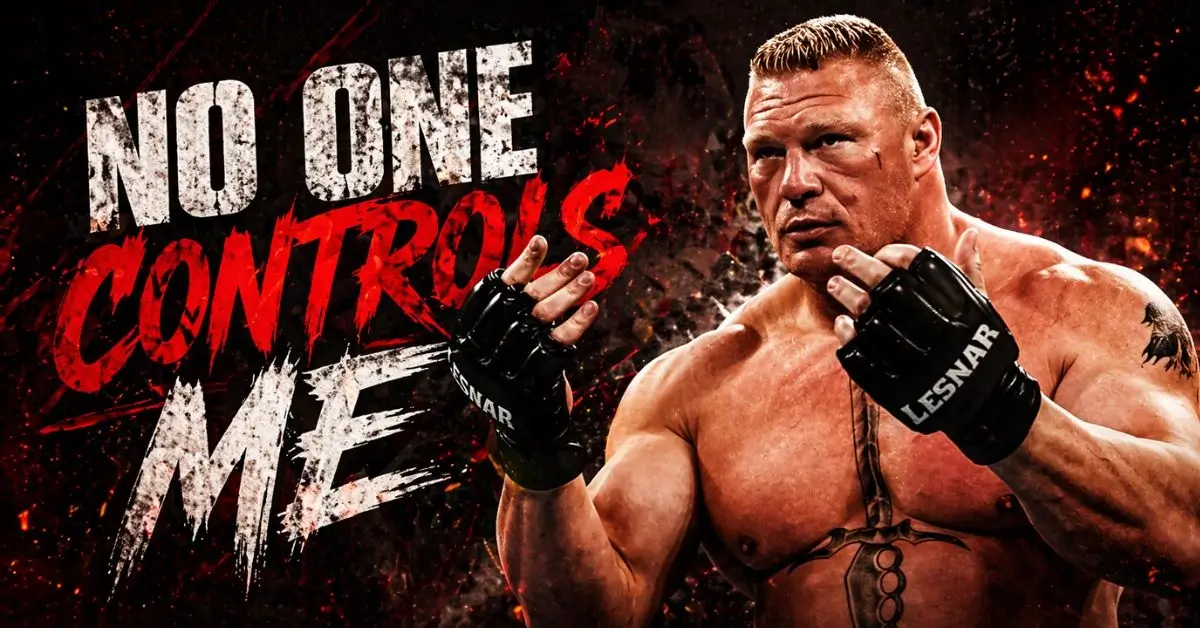
Fans witnessed something they weren’t supposed to see; for as often as he followed the script, these five moments prove that even WWE could not control this “Beast.” And what makes this story so compelling is that it begins with control and ends without it. WWE is a machine built on control. Every camera angle is predetermined. Every punch is faked. Every match follows a script. Announcers know exactly what to say. Wrestlers know exactly where to go. Even the blood is, at times, fake.
This is not a legitimate sport. It is a show. And those who run WWE want to keep it that way. They control everything to ensure that nothing goes wrong. They want safe fights. They want happy endings. They want everyone to follow the rules. The company has spent decades building a system where nothing is left to chance. They rehearse their moves in the ring before the show begins. They predetermine every single line of their interviews. They know exactly when to cut to a commercial break. They know exactly when to zoom in on someone’s face. They know exactly when to cue the music. Everything is timed. Everything is scripted.
Everything is safe. But then came Brock Lesnar. And Brock Lesnar was different. He didn’t grow up dreaming of becoming a professional wrestler. He had no love for costumes or storylines. As a child watching wrestling, the thought never crossed his mind: “That is exactly what I want to do.” He viewed WWE as nothing more than a job—just a job, a means to earn a living. First and foremost, he was a legitimate fighter. He had won college wrestling championships at the University of Minnesota. He was the NCAA Division I Heavyweight Champion. He also fought in the UFC and became the UFC Heavyweight Champion. He knew how to inflict real pain on people.
He had spent his entire life training to break people’s arms and knock them unconscious, and that is precisely what made him so dangerous—because when you put a real fighter into a staged fight, things can go horribly wrong. Other wrestlers are merely actors playing the role of a “tough guy.” But Lesnar was a genuine “tough guy” playing the role of an actor—and he never fully embraced the act. Let’s begin with the moment that demonstrated Lesnar didn’t just break the rules inside the ring; he completely disregarded them backstage as well.
Table of Contents
5 Times When Brock Lesnar Lost Control Even WWE Couldn’t Stop It
1. 2018 WrestleMania 34 Brock Lesnar vs Roman Reigns
The date was April 8, 2018. WrestleMania 34—the biggest show of the year. Over 70,000 people were packed into the Superdome in New Orleans. Millions more were watching from home. Lesnar was battling Roman Reigns for the Universal Championship. The WWE wanted Reigns to win. They had been building toward this moment for years. Reigns was destined to become the next big star—the next John Cena, and the new face of the company. They wanted him to defeat Lesnar and become the champion. They wanted the crowd to cheer him on. They wanted a “happy ending”—but the crowd couldn’t have cared less.
The show lasted for seven hours. The audience was completely exhausted. They had been seated since the afternoon. By the time the main event began, it was already midnight. People were tired. They were bored. During the match, they were tossing beach balls around. They were chanting, “Boring!” They were shouting, “This sucks!” They had no desire to watch any more wrestling. And Brock Lesnar sensed it.
He could feel the energy—or rather, the lack thereof—within the building. He was risking his life in the ring, yet no one seemed to care, and that infuriated him. It made him absolutely furious. When the match finally ended, Lesnar emerged victorious. In a shocking conclusion, he retained his title belt. He pinned Reigns and remained the champion.
The crowd booed. Not because they were fond of Reigns, but because they had grown equally weary of Lesnar. They were fed up with both wrestlers. Lesnar grabbed his belt and headed backstage. Moving behind the curtains, he made his way to the area known as the “Gorilla Position.” This is where Vince McMahon sits during the show. Vince is the boss. He is the Chairman of the WWE. He founded the company. He owns it. He makes all the major decisions. And Brock Lesnar marched straight up to him; he was seething with rage.
Absolutely furious. Then, Lesnar did something that no other wrestler would ever dare to do. He violently ripped the championship belt from his waist. The Universal Championship belt is quite large. It is crafted from leather and metal plates. It is quite heavy—weighing approximately ten pounds—and Lesnar hoisted it up and hurled it with all his might. He hurled the belt across the room, straight at Vince McMahon.
The belt flew through the air like a Frisbee. One of the belt’s straps narrowly missed striking the face of a producer named “Road Dogg.” Later, Road Dogg recounted that he was terrified in that moment. He explained that the belt landed right in front of Vince. It hit the floor with a loud thud; the metal plates clanged against one another. It was a close call—too close for comfort.
Road Dogg remarked that while it was technically safe, one of the belt’s straps had come perilously close to hitting him right in the face. Then, the situation escalated further. Shane McMahon was also present there. He is Vince’s son—a WWE executive who also happens to be a wrestler. He witnessed Lesnar throwing the belt at his father. And Shane didn’t care in the slightest that Brock Lesnar was a trained UFC fighter.
He saw that his father was being disrespected. So, Shane sprang to his feet. He wanted to fight Brock Lesnar. Road Dogg recalled that Shane was furious and attempting to confront Brock. He was ready to throw punches. He was prepared to defend his father’s honour, but Road Dogg held him back. He grabbed Shane and pulled him away, saying, “Hey, let it go. Let’s just stand right here and keep our teeth intact,” because everyone knew exactly what would happen if a fight broke out between Shane and Lesnar.
Lesnar is a trained UFC champion. He has competed against the best fighters in the world. Shane would have been absolutely demolished. He would have suffered severe injuries. Thus, Road Dogg saved him. He stopped the fight before it could even begin. And what did Vince do? Nothing. He didn’t fire Lesnar. He didn’t impose any fine on him. He didn’t even yell at him. Lesnar simply walked away. He left the building. And nothing happened to him, because Lesnar was above the rules.
That night, he proved it. He threw a belt at his boss and still got away with it. Had it been any other wrestler, they would have been fired on the spot, but that didn’t happen with Lesnar, because WWE needed him. They needed his name. They needed his prestige. They needed the fact that he was a legitimate fighter. Therefore, they let him do whatever he pleased—and Lesnar knew it. He knew that all the power lay with him, and he wielded that power. This was not the first time Brock Lesnar had demonstrated that he had absolutely no regard for any authority or regulations.
2. 2018 Royal Rumble Brock Lesnar vs Braun Strowman vs Kane
Just a few months prior—at the Royal Rumble in January 2018—something entirely different unfolded. Lesnar was competing in a “Triple Threat Match” against Braun Strowman and Kane. Strowman is a colossal figure; he weighs 385 pounds and ranks among the strongest men in the WWE. During the bout, Strowman’s knee accidentally collided with Lesnar’s head. It was a brutal blow—far harder than intended—and Lesnar did not take kindly to it at all.
Right there in the ring, with the cameras rolling, Lesnar dropped his “act.” He turned around and delivered a thunderous punch to Strowman. A genuine punch—thrown with full force—landed squarely on his temple. Even Strowman—one of the strongest men in the WWE—was visibly shaken by the impact. His head snapped to the side; he staggered.
The cameras captured Brock Lesnar saying, “Slow down, you idiot.” It was Lesnar delivering a “receipt” to Strowman. In the world of professional wrestling, a “receipt” signifies that you intentionally inflict real physical pain upon someone in retaliation—to teach them a lesson, to demonstrate who the real boss is, and to make them realise the magnitude of their mistake. And Lesnar did all of this live on pay-per-view television, for the entire world to see.
The WWE took no action against him, simply because they couldn’t. Brock Lesnar operated by his own rules. If anyone disrespected him, hit him too hard, or put him in jeopardy, he would inflict genuine injury upon them. And no one could stop him. Neither the referee, nor the producer, nor even Vince McMahon himself.
3. 2015 Monday Night Raw: Brock Lesnar and The Undertaker Feud
Now, let’s go back to 2015. It was a moment of a different kind. It happened on television. The date was July 20, 2015, and the show was Monday Night Raw. The broadcast aired live from Dallas, Texas. Lesnar and The Undertaker were set to clash in a major event known as SummerSlam. These two shared a history—a genuine history. It dates back to 2010, during a UFC event; Lesnar had just lost his UFC title.
As he was walking backstage, The Undertaker was in the middle of giving an interview. The Undertaker looked at Lesnar and asked, “Do you want to fight me?” It was a challenge—a genuine challenge. At that very UFC event, two distinct worlds collided—wrestling and legitimate combat—and it was there that the foundation for their future rivalry was laid.
By 2015, that rivalry was at its absolute peak. Brock Lesnar had broken The Undertaker’s “Undefeated Streak” (his continuous winning streak) at WrestleMania. He had accomplished something that no one had ever even dared to imagine. For 21 years, The Undertaker had remained undefeated at WrestleMania, and Lesnar had brought that streak to an end. So now, they were set to face off once again at SummerSlam.
WWE wanted to generate a tremendous buzz among the audience regarding this matchup, so they devised a plan for a massive brawl to take place on Raw. They wanted this altercation to appear completely out of control. They wanted wrestlers from the entire locker room to come rushing out to try to break up the fight. And that is exactly what happened. However, things went a little too far.
This segment began in a rather ordinary fashion. Lesnar came out. The Undertaker came out. And then, a brawl erupted between the two. However, in the blink of an eye, the fight escalated into sheer pandemonium. Lesnar and the Undertaker rained punches upon one another, slamming each other repeatedly into the canvas. Security guards attempted to intervene, but Lesnar tossed them aside like mere playthings. He grabbed one guard, hoisted him up, and flung him aside as if he weighed absolutely nothing. Then he threw a second guard, followed by a third. It was only then that the actual wrestlers emerged. A multitude of wrestlers. The entire locker room emptied.
Big wrestlers, small wrestlers, seasoned legends, fresh faces—everyone was present. And together, they made a strenuous effort to pry Lesnar and the Undertaker apart. Yet, Lesnar kept fighting. His face turned crimson—a vivid, bright red, like a tomato. The veins in his neck bulged outward—thick, distended veins. He was gasping for air—breathing heavily, violently. The sound of his laboured breathing could be heard distinctly. And then, something truly terrifying was picked up by the microphones.
Voices were screaming, “Don’t touch me!” and “Calm down, Brock!” These were not scripted lines. These were real people—genuinely terrified people. Smaller wrestlers who wanted no part of this melee; who didn’t want to get hurt, even by accident; who wanted to avoid injury at all costs. Because when Lesnar starts tossing people around, anyone can get hurt.
Even those who were not directly involved in the brawl heard what Lesnar shouted at The Undertaker. He bellowed, “I’m going to kill you!” And it didn’t feel fake. It felt absolutely real. Too real. The way he said it—the tone of his voice, his facial expressions—everything seemed authentic. Watching it all unfold from home, some viewers wondered if Brock Lesnar had perhaps forgotten that this was all just a show.
Maybe he really was furious. Maybe he had let his true emotions surface. Maybe he had genuinely lost his temper. In reality, the entire incident was supposed to be staged. But it felt dangerous—because Lesnar is, in fact, a dangerous man. He is a legitimate fighter. And when a real fighter gets angry—even if it’s just for show—people get nervous. That moment proved a crucial point.
The WWE wanted chaos to erupt. They wanted the whole scene to look wild and out of control. They wanted the audience watching at home to think, “Wow! This has completely spiralled out of control.” But they were playing with fire. Because Brock Lesnar isn’t like other wrestlers. He is capable of genuinely hurting someone. And when you ask him to pretend to be out of control, sometimes he comes dangerously close to actually becoming out of control. That fine line between reality and fiction blurs, and people get scared.
4. SummerSlam 2016 Brock Lesnar vs Randy Orton
Exactly one year later, that line vanished completely. At SummerSlam 2016, Lesnar faced off against Randy Orton. Orton is a highly experienced and seasoned professional wrestler. He has been wrestling for nearly twenty years. He knows how to work safely. He also knows how to make things look absolutely real without actually hurting anyone. But during that match, Lesnar genuinely injured Orton. He used his elbows—vicious elbows, hard elbows.
He busted Orton’s head wide open. Real blood. Lots of blood. The wound was so deep that Orton’s skull—the white bone beneath the skin—was clearly visible. It was a gruesome and harrowing sight. And no one knew whether or not this was all part of a pre-planned script. Backstage, another wrestler named Chris Jericho watched it all unfold on the monitors. He, too, is a highly seasoned veteran. He has been a part of the WWE for decades. And he thought Brock Lesnar had completely lost his mind.
He believed Brock Lesnar was genuinely attacking Orton. So, Jericho sprinted backstage. He was fully prepared to confront Lesnar. When Lesnar emerged from behind the curtain, Jericho stepped right up and stood nose-to-nose with him. Jericho later remarked that, if necessary, he was even prepared to bite Lesnar’s nose off. He said, “Either you stand your ground and fight with everything you’ve got, or you tuck your tail between your legs and run.” And he added, “I’ve never been that kind of person.” That is just how serious the situation was. Even other wrestlers couldn’t tell when Lesnar was merely acting and when he was doing it for real.
The line between the show and reality had completely blurred. And this unnerved everyone, because if Brock Lesnar could do something like this to a seasoned veteran like Randy Orton, he could do it to anyone.
5. 2004 WrestleMania XX, Brock Lesnar vs Goldberg
Now, let’s go even further back—to the year 2004. This is one of the strangest stories of all, because this time, WWE didn’t lose control over Lesnar; instead, they lost control over the crowd. The date was March 14, 2004; the venue was Madison Square Garden in New York; and the occasion was WrestleMania XX. The match featured Brock Lesnar against Goldberg. Both were massive stars. Both were incredibly powerful. Both were nothing short of monsters.
This match should have been spectacular—a “dream match.” Two powerhouses were set to collide, but that’s not what happened, because the fans had caught wind of a secret. They knew that Brock Lesnar was leaving WWE. They also knew that Goldberg was leaving WWE. This news had leaked online just a few days before the match. The “dirt sheets”—websites dedicated to covering wrestling news—had also published the story. And the fans were furious about it. They felt betrayed. Both of these wrestlers had earned millions of dollars from WWE.
WWE had elevated them to the pinnacle of success, giving them everything they desired, and now they were simply going to walk away from it all. Brock Lesnar wanted to try his luck in the NFL; he wanted to play football for the Minnesota Vikings. Meanwhile, Goldberg’s contract had expired, and he had no intention of renewing it. So, both wrestlers were set to depart from WWE after this match—a fact the fans were well aware of. Consequently, they decided to ruin the match. They decided to hijack the entire show. And that is exactly what they did.
The moment Lesnar and Goldberg entered the ring, the crowd began to boo loudly—their voices were so deafening that they could have burst eardrums. They chanted, “You sold us out!” They sang, “Na, na, na, na… Hey, hey, hey… Goodbye!” They yelled, “This match is boring!” They had absolutely no interest in the bout itself. They simply wanted to inflict psychological pain upon Lesnar and Goldberg. They wanted to punish them—and they succeeded. Later, Goldberg revealed that some wrestlers backstage were actually laughing at the situation.
They found the whole spectacle amusing; however, other wrestlers were left completely shocked and appalled by what they witnessed. They simply could not believe that fans would go to such lengths to ruin a match. This was the Main Event of WrestleMania—the biggest show of the year—yet the crowd couldn’t have cared less. Anger was clearly etched across Brock Lesnar’s face; you could see the fury in his expression. He slowed his pace. He refused to work hard for people who hated him. He had no desire to put on a show for the very people who were booing him.
The match turned out to be a complete disaster—slow and awkward, with long lulls between manoeuvres. Both wrestlers simply stared each other down; neither seemed to care in the slightest. WWE executive Bruce Prichard later remarked that the match was so bad, it practically reeked. It was an embarrassment. It was the biggest show of the year, yet the crowd had completely hijacked it.
WWE had lost control—not over the wrestlers, but over the audience. And perhaps, that was even worse. Then, it was over. Finally, after 15 long, agonising minutes, Goldberg secured the victory with his signature ‘Jackhammer’ manoeuvre, yet the fans continued to boo. They booed both wrestlers. Consequently, the special guest referee, “Stone Cold” Steve Austin, decided to do something to appease the fans.
He executed his finishing move—the ‘Stone Cold Stunner’—on both wrestlers. First, he hit Goldberg with the Stunner. The crowd erupted in cheers. Then, he hit Lesnar with the Stunner. The crowd cheered even louder. But before that could happen, Brock Lesnar did something shocking. He looked out at the crowd and flipped them his middle finger. With both hands.
Directed right at the 18,000 fans—specifically the very people who had paid good money to be there—he offered two middle fingers. It wasn’t in the script. It was genuine rage. Lesnar was so furious that he broke character completely. He showed everyone exactly how he truly felt. He was tired of pretending to care. He was tired of pretending to respect the fans. And then, he walked away. That night, he left WWE—and he wouldn’t return for another eight years.
Backstage, Vince McMahon was absolutely livid. He was completely unhinged with rage. He confronted Brock Lesnar at a spot known as the ‘Gorilla Position.’ This is the area located just behind the curtain—the very place where Vince sits with his headset during the show. Yet, Vince didn’t shout; he didn’t pick a fight, for Lesnar looked like an enraged Viking.
WWE announcer Jim Ross remarked that Lesnar resembled a bull—a massive, furious, and dangerous beast. He was colossal, seething with rage, and ready to inflict harm upon anyone. His face was crimson. His fists were clenched tight. His jaw was locked rigid. Consequently, Vince simply shook his hand. He let Brock Lesnar walk away—for what else could he have done? Fire him? Brock Lesnar was quitting on his own terms anyway. Fight him? Lesnar would have annihilated him.
So, Vince lost. WWE lost. The crowd had hijacked the show, and Lesnar had simply stopped trying. It was an absolute disaster. No one was in control—not the company, not the wrestlers, no one at all. This moment proved that even WWE—with all its money, power, and control—cannot suppress genuine human emotion. They could not force the crowd to cheer. They could not force Brock Lesnar to care. And when those two elements crumbled, the show crumbled along with them. It was a shattering of the ‘fourth wall’—and in the worst possible way.
The illusion had been shattered. Everyone could see that this was merely a business—just a job—and that its magic had faded away. It took WWE eight years to recover from this and bring Brock Lesnar back. And when he finally returned in 2012, he was even bigger, even more dangerous, for he had proven that he did not need WWE. WWE needed him. Now, let’s talk about something different. Let’s discuss that one instance when WWE actually wanted to lose control—yet, in reality, they failed to do so.
WWE show him as a Man with superpowers
2003 SmackDown: Brock Lesnar vs The Big Show
They merely made it look that way. The date was June 12, 2003. The show in question was SmackDown. It was being taped in North Charleston, South Carolina. Brock Lesnar was facing off against “The Big Show.” The Big Show is a colossal figure; he stands 7 feet tall and weighs 500 pounds. Lesnar weighs approximately 300 pounds. Their combined weight totalled roughly 800 pounds.
A match was underway between the two. As the match reached its climax, both men climbed onto the top rope of the ring. Brock Lesnar was preparing to execute a “suplex” on The Big Show from the top turnbuckle. A suplex is a dangerous manoeuvre in which both wrestlers fall from the top rope down onto the mat below. And then, something happened that no one had anticipated.
The ring collapsed with a thunderous crash. Its support posts snapped. The ropes went slack. The entire structure of the ring caved in. The mat sank inward. It appeared as though the ring simply could not bear the weight of the two men. It seemed as though the ring could not withstand the impact when that combined weight of 800 pounds came crashing down all at once. It looked exactly like a genuine accident—a bizarre, freak occurrence. And the audience was left utterly stunned by the sight.
They erupted into screams and shouts. They simply couldn’t believe what they had just witnessed. The commentators—Tazz and Michael Cole—fell completely silent. They were left utterly stunned, as if they couldn’t find the words to describe what had happened. The referee—Mike Chioda—also sold the incident as if it were entirely real. When the ring collapsed, he went down with it. He looked shocked, distressed, and terrified, and for over a decade, WWE maintained that the incident was absolutely genuine.
“The Big Show” also told the public the very same thing—that it was all real. He gave numerous interviews, stating, “Yes, we actually broke the ring.” Brock Lesnar behaved in the same manner, acting as though it were all true. The referee played along as well, making it appear completely authentic. Everyone lied. They lied in interviews. They lied on television. They even lied in documentaries. They wanted the fans to believe that Brock Lesnar was so powerful and dangerous that he had literally demolished the ring. They wanted the fans to feel that Lesnar’s strength was so immense that even WWE’s equipment couldn’t withstand it. But it was all a lie. A complete fabrication.
In 2015, “The Big Show” finally admitted the truth. He stated, “In hundreds of interviews, I lied through my teeth and claimed it was a ‘shoot.’ A ‘shoot’ implies something real—something that hasn’t been planned. But this wasn’t a shoot. It was a ‘work.’ It was planned all along.” He added, “If you have the opportunity to make people forget reality—even if only for a fleeting moment—it’s a good thing for them.”
They had rigged the ring. They had pre-cut the support posts. They had compromised the structural integrity of the frame. They had even installed airbags beneath the ring to ensure that the impact of its collapse looked and felt authentic. A stunt coordinator named Ellis had orchestrated this entire setup.
She knew exactly how to make it look authentic. The referee knew. The wrestlers knew. The producers knew. Only the audience was kept in the dark. It was a manufactured spectacle. WWE wanted people to believe that Brock Lesnar was uncontrollable. They wanted people to think of him as a monster capable of smashing anything, of destroying anything; and so, that is exactly what they did.
They controlled every single aspect of it, yet presented it as if it were completely out of control—and the strategy worked. To this day, people still talk about that incident where the ring collapsed. They replay that video time and again. It stands as one of the most iconic moments in WWE history—and it was entirely fake. But that, ultimately, is the point.
WWE knows how to make the fake appear real. Their entire business rests upon this foundation. They sell illusions. They sell stories. They sell memorable moments. And this was a truly magnificent moment. It proved that when WWE chooses to feign a loss of control, it can execute the act with absolute mastery. They can script chaos. They can orchestrate a disaster with meticulous precision. They can even make danger itself look authentic. And Brock Lesnar was the perfect individual to carry this off, for he already possessed a menacing aura. His very presence exuded a sense of danger. He was a 295-pound
When Brock fights with care
2003 WrestleMania 19 Brock Lesnar vs. Kurt Angle
It was the month of March. April 30, 2003: WrestleMania 19. Safeco Field in Seattle, Washington. The Main Event: Brock Lesnar vs. Kurt Angle for the WWE Championship. This match should never have taken place because Kurt Angle’s neck was literally broken. This wasn’t merely part of the storyline; it was genuinely broken. Doctors had advised him to undergo immediate surgery. They had told him not to wrestle. They had warned him that he could end up paralysed. He could even have lost his life, but Angle refused. He is an old-school performer. He believes in tradition.
He wanted to lose his title right there in the ring. He wanted to do it the right way. He wanted to properly pass the torch to the next generation. And so, despite his broken neck, he fought the match. Consequently, the entire burden fell upon Lesnar. Brock Lesnar had to protect Angle.
He alone had to shoulder the responsibility for the entire match. He had to ensure that absolutely nothing went wrong—because if Angle sustained even the slightest wrong injury, if he took a bad fall, or if his neck suffered a wrong impact, he could have been paralysed. In front of 54,000 people, live on pay-per-view, he could have lost his life right there in the ring.
Brock Lesnar was only 25 years old. He had less than two years of television experience, and in the main event of WrestleMania, he was tasked with carrying a match against a wrestler with a broken neck. The pressure on him was immense. Initially, the match went smoothly. The two wrestlers battled for nearly 20 minutes. They locked up, executed suplexes, and delivered a thrilling contest. But then, Lesnar decided to attempt something risky—something foolish. He climbed up to the top rope. He was about to perform a backflip manoeuvre known as the Shooting Star Press. It is an incredibly difficult move—truly, exceptionally difficult. It demands precise timing, precise rotation, and a precise landing.
Most wrestlers who execute this move are smaller in stature; they weigh 200 pounds or less—wrestlers like Billy Kidman, for instance, who are cruiserweights. Brock Lesnar weighed 295 pounds, though he had successfully performed the move before—during his training at Ohio Valley Wrestling—when he was fresh and unwearied. The idea to attempt it at WrestleMania belonged to Kurt Angle. Angle believed it would be spectacular. He felt it would be the moment everyone would remember—the moment that would define Lesnar’s career. And he was right—though not in the way he had intended.
Brock Lesnar ascended the top turnbuckle. The crowd was buzzing with anticipation; they had no idea what was about to unfold. Angle waited in the ring; then Lesnar leapt—and everything went horribly wrong. He was utterly exhausted. The match had already spanned nearly 20 minutes. His muscle fibres were fatigued; his legs felt heavy. The ropes were slick with sweat and moisture. The stadium was an open-air venue, and the Seattle weather had created a layer of dew.
Angle was positioned slightly too far away—leaving Lesnar with a much greater distance to cover than the move typically required. So when Brock Lesnar leapt, he didn’t get enough rotation. His rotation stalled. He hung suspended in mid-air. His body stopped flipping over. And instead of landing chest-to-chest with Angle, he plummeted straight down and landed squarely on his head—his forehead, the very crown of his skull. His entire 295-pound weight crashed down upon his head and neck. His neck compressed like an accordion. His spine buckled. The impact was tremendous. The sound was horrific—a heart-stopping thud. The crowd gasped, and then silence fell. Absolute silence.
No one knew what to do. No one understood what had just happened. Kurt Angle lay there with a broken neck, watching as Lesnar crashed head-first to the mat. And Angle thought, “Oh God, he’s broken his neck, too.” For fifteen agonising seconds, the WWE had absolutely no control.
The match was supposed to end with Brock Lesnar executing his signature move and securing the victory—a spectacular finish, a defining moment. But Lesnar was unconscious. He had suffered a severe head injury. His mind had gone numb. He couldn’t think clearly. He couldn’t even move properly. All the plans went out the window. The script was rendered useless. And no one had the slightest idea what to do next.
Angle began to panic. He later recounted that this was one of the most stressful moments of his life. Lying there, he thought to himself, “I cannot hold onto this title for even one more day. My neck is broken. I am physically unable to wrestle again.” But Brock’s neck might have been broken, too. What were they to do now? The referee, Mike Sparks, was completely flustered. He looked from one wrestler to the other, trying to figure out a course of action, attempting to make contact with the officials seated at ringside, and struggling to bring the situation under control—yet no viable solution presented itself. So, Angle took charge himself.
Despite his broken neck and the excruciating pain, it was Angle who orchestrated the conclusion of the match. He instructed the referee on exactly what to do. He crawled over to Brock Lesnar. He pinned him down in an attempt to secure the fall. Then, he whispered into Lesnar’s ear, “Kick out. Please, kick out.
You have to kick out.” He was pleading—begging—because if Brock Lesnar didn’t kick out, Angle would remain the champion. And Angle was no longer in any physical condition to continue as champion. His body had completely given out. One more match could cost him his life. One more jarring impact could leave him permanently disabled. The title had to change hands. It was inevitable.
Somehow, Brock Lesnar managed to kick out. He was in a state that Angle describes as “Loopy Street”—a complete loss of mental faculties. He was dizzy, disoriented, confused, suffering from a head injury, and operating entirely on pure instinct and muscle memory. But he kicked out. And then he slowly rose—staggering, wobbling. He could barely stand. And then, somehow, he executed his ‘finishing move’: the F5.
He hoisted Angle onto his shoulders, spun him around, slammed his face violently into the mat, and pinned him. One, two, three. The new champion, Brock Lesnar, had won. The crowd erupted in jubilation, yet Lesnar didn’t even fully know where he was. He had just returned from the brink of death on live television, and yet he finished the match—because that is what the WWE demanded.
The show must go on, even if it costs someone their life. Angle later remarked, “I was in a situation where Brock could have broken his neck. He had been knocked unconscious. I didn’t know what to do, because I couldn’t hold onto the title for even one more day.” He added, “I actually had to wake him up and get him ready to move. It was incredibly stressful. Those 15 seconds were among the most stressful moments of my life. Both wrestlers were fighting despite being injured.”
Both wrestlers were just one wrong move away from paralysis, yet they completed the match. This moment changed everything. The WWE realised that they could no longer allow heavyweight wrestlers to attempt such manoeuvres. It was simply too risky. Brock Lesnar could have been paralysed. He could have even lost his life—and on live television, no less, in front of millions of viewers worldwide.
Consequently, following that night, the WWE placed a complete ban on the ‘Shooting Star Press’ manoeuvre for heavyweight wrestlers. They revamped their wrestler training protocols. They became far more cautious regarding the specific moves they permitted. He focused more on safety than on spectacle—at least for a while. But strangely enough, this very moment made Lesnar even more famous.
People watched him nearly die, and then watched him rise and finish the match. This made him seem invincible. He began to resemble a true “monster”—someone impervious to injury, as if he were a “superhuman.” Kurt Angle remarked, “The best part about it is that this is the very thing people remember most about WrestleMania 19. It was a monumental moment for him.” So, even though WWE had lost control of the match, they gained something in return.
They acquired a “legend”—a story that people would never forget. They obtained proof that Brock Lesnar was far stronger than any other wrestler. After all, who else could fall directly on their head, lose consciousness, and still win the championship? No one. Only Lesnar. So, what does all this signify? It means that Brock Lesnar was never merely a wrestler. He was a “problem” that WWE could never quite solve.
From reckless stunts to acts of genuine violence, he broke every rule. He hurled his championship belt at his boss and walked out. He flipped an obscene gesture to the 18,000 fans packed into Madison Square Garden and quit the company. He nearly died attempting a foolish stunt, yet he still finished the match. During a scripted bout, he even intimidated other wrestlers, leaving them unable to discern whether he was merely “acting” or genuinely fighting.
When his temper flared, he would land legitimate punches on people. And while most wrestlers would have been fired for any single one of these transgressions, Brock Lesnar was not. He kept coming back—time and again. And with each return… he commanded even more money.
He continued to do exactly as he pleased, because WWE needed him far more than he ever needed WWE. In a world of staged fights, he was a genuine fighter. And that is precisely what made him special. That is what made him invaluable. That is what made him a multi-millionaire. Even when he was dangerous, even when he was unruly, even when he intimidated other wrestlers, even when he defied his boss, other wrestlers merely dream of being in the WWE. They love the show. They love the fans.
They love the travel, the lights, and the music. They follow the rules because they are grateful just to be there. But Brock Lesnar never showed gratitude. He never even pretended to enjoy any of it. He carried himself as if the WWE was the one lucky to have a fighter like him. And perhaps they truly were lucky, for he brought something to the table that no one else could.
He brought with him the fear that something real might actually happen—that he might genuinely hurt someone, that the script could go off the rails at any moment, that chaos could erupt. And in a business built on staged fights and scripted storylines, that fear is worth millions. That sense of the unknown—that unpredictability—is the rarest commodity the WWE can sell, because everything else is controlled. Everything else is predetermined. Everything else is safe.
But with Brock Lesnar, you never knew. You never knew if his patience might snap, if he might cross the line, or if the true fighter within him might suddenly break loose. And that is why every Brock Lesnar match felt dangerous. Every Lesnar segment felt significant. People paid attention to him because they knew that with Brock Lesnar, anything could happen—and sometimes, it actually did. That is what made him so dangerous. And that is why WWE could never fully tame that ‘beast’.
Also Read | 6 WWE Wrestlers Roman Reigns Is Friends With & 5 He Hates in Real Life